Over the past month we have looked at a few traditions that many of us embrace during the holidays. Everything from Santa, himself, to why those random branches are setting on the mantle. But why? What does it matter why we have these customs? Well, it’s the same reason we should want to know about any tradition. With understanding comes appreciation.
In the spirit of that same appreciation, I would like to sincerely thank all the readers of this journal for your time and especially your feedback. A special thanks to Crystal, who has been the greatest editor anyone could ask for. I mean, come on, who wouldn’t want someone to point out every single flaw in your writing! Seriously, this journal wouldn’t be nearly as enjoyable without her making sense out of all of my ramblings.
I pray that this holiday season, you will look past not only the traditions of your own holiday, but past all of the traditions in your life. Seek to know why you do the things you do. Seek to understand the importance of traditions in your life today.
The apostles of Jesus Christ had a hard time with this. But they did not understand what he meant and were afraid to ask him about it. Mark 9:23 They were afraid. May this not be our heart. For Jesus has promised, “Seek and you will find.” More importantly, seek Him and you will find Him.
I wish everyone a very, merry Christmas. May we truly understand, appreciate, and experience Christ this season and the upcoming year. Thanks again for reading.
Thursday, December 22, 2005


Monday, December 19, 2005
Traditions of Christmas. Part 4
 “Ho! Ho! Ho! Merry Christmas!!!” bellows the man in red donning the bag of goodies. Making his list and checking it twice, this bearer of the endless sack of treasures is the central figure in what many consider the most important part of Christmas…GIFTS. For some gift giving is what makes the holiday season feel like Christmas. For others (probably too many), gift receiving is their focus. But when and where did this tradition begin? Who started this annual ritual of braving the treacherous shopping mall to find the last Xbox 360?
Many equate this custom with the Biblical account of Jesus’ birth. In the book of Matthew, the Magi came bearing gifts from the King Herod of Judea—gold, frankincense, and myrrh. However, most associate it with Santa Claus himself.
Nicholas was born in Lycia, Turkey, in the mid-3rd century and would later become bishop of Myra. Centuries after his death and burial at his church at Myra, Nicholas’ reputation for generosity and compassion led to the rise of legends in which he gave to the poor, protected the weak, and even restored life to deceased children. These legends persisted until after the Protestant Reformation of the 1500's. All stories eventually subsided in Europe except for the tale of Sinterklaas (a Dutch version of the name Saint Nicholas) in Holland. Dutch colonists brought this tradition to America where it fused with the Nordic tale of a magician who punished the naughty children and rewarded the nice.
The legend continued to escalate in 1822 with Clement Moore’s The Night Before Christmas, in which Santa Claus was given his sleigh and bag of toys. From the 1860’s through the 1880’s , Thomas Nast illustrated Santa Claus in Harper’s Magazine which gave birth to his famous checklist and his wonderful workshop at the North Pole.
And here we are…2005. Presents under the tree are now, not just anticipated, but expected. It seems that every year that goes by, there are more and more presents to buy. This holiday season as we notice the presents under the tree, let them remind us of the greatest Present ever—Jesus. A Gift given—to not one person—but to humanity. A Gift wrapped—not in beautifully adorned paper and ribbon—but in a lowly, disgusting, common trough. A Gift—not of joy—but of Joy!! It seems the only characteristic this Gift has in common with the millions of other gifts given world wide is that this One didn’t stay wrapped for long. Jesus was placed in a modest manger at His birth, but He didn’t stay there, for He was purposed for a cross. Upon taking our sins to the cross with Him, Jesus was placed in yet another common holder—a tomb.
“Now there was a man named Joseph, a member of the Council, a good and upright man, who had not consented to their decision and action. He came from the Judean town of Arimathea and he was waiting for the kingdom of God. Going to Pilate, he asked for Jesus' body. Then he took it down, wrapped it in linen cloth and placed it in a tomb cut in the rock, one in which no one had yet been laid.” Luke 23:50-53I don’t know about you, but when I think of Christmas morning, I don’t recall gifts placed neatly under the tree. Mine are more like visions of shredded wrapping paper scattered across the floor. The sorry remains of what used to be boxes. And a multitude of large garbage bags strategically placed throughout the room. It didn't take us long to tear into the presents that were set aside just for us. These gifts were wrapped for just a moment. Likewise, Jesus was only in the tomb for just a moment. The grave, for everyone else, is an eternal dwelling place physically. But Jesus conquered it—after only three days. Praise God, the Almighty Sovereign and the Omnipotent Savior.
"Praise be to the God and Father of our Lord Jesus Christ! In his great mercy he has given us new birth into a living hope through the resurrection of Jesus Christ from the dead, and into an inheritance that can never perish, spoil or fade—kept in heaven for you." 1 Peter 1:3-4This Christmas morning, as you receive that scarce moment of peace just following the hectic aftermath of chaos, look around. See those empty boxes? See the joy on the their faces? Isn’t the empty box a lot nicer than before? The mystery of what was inside has now been revealed. Gifts are nice…but only when they are opened. Jesus’ crucifixion was amazing, but His resurrection was essential. If He had stayed in the tomb…His death would have been pointless. This was His ministry. He gave His life for it. And it all started with a manger.
I wish each and every one of you a very merry Christmas and may Jesus Christ bless your heart this holiday season.
Monday, December 12, 2005
Traditions of Christmas. Part 3
 The holiday season is time for memories. Hot chocolate by a fire watching it snow outside. Gathering with family and listening to the chatter of long-overdue “catching up.” Singing Christmas carols with the pleasant…sometimes unpleasant...voices of friends and neighbors. Many of our fondest memories are focused around the pinnacle of our Christmas decorations—the Christmas tree. Pulling out the ornaments and reminiscing as each memory is hung. Sitting in front of the illuminated tree and reading the Christmas story of the New Testament. Watching children tear into presents with eyes as wide as the saucer of milk and cookies set out the night before. Following your dad after cutting down your first Christmas tree with “Dad’s Hatchet” and accidentally attempting to chop down your own knee with that same hatchet on the walk back to Dad’s truck.......WHAT?!?!?.....well, that’s another story for another time. Nevertheless, the Christmas tree is a staple in many homes world wide, and yet many know very little about its beginning.
Last week we touched on the holly branch and its role in ancient cultures celebrating the hope of the upcoming spring. Many of these societies believed that winter came as a result of their sun god becoming ill. Egypt worshipped Ra. The Vikings revered Balder. And the Romans deified Saturn, their god of agriculture. December 21 or December 22—the beginning of the winter solstice—would normally mark the beginning of these festivities, and the evergreen plants—trees in particular—became a fundamental part of these celebrations. Evergreens would soon become associated with paganism because of these customs.
16th century Germany is recognized with starting the Christmas tree tradition as we now know it. When German immigrants settled in Pennsylvania in the 1600’s, they brought these traditions along with them; however, the strict conduct of the New England Puritans denounced these “pagan” ways. William Bradford governed against it. Oliver Cromwell preached against it. The General Court of Massachusetts ruled against it stating any observance of December 25 was a penal offense. This legacy continued until the royal English family of Queen Victoria, including her husband Prince Albert of Germany, were illustrated in the London News standing around their Christmas tree; thus, popularizing the tradition in England and East Coast America.
I don’t know about you, but Christmas just wouldn’t seem like Christmas without a tree. It could be the sparkle of the lights, the beauty of having nature (or the imitation of nature, in my case) indoors, or the challenge of keeping our cats from climbing the tree or pulling the ribbon off the branches. Nevertheless, it is an vital element in the feeling of Christmas. This symbol of Christmas joy reminds us of another tree that also brought about celebration—the cross of the Savior of the world.
The story of Christmas in completed with the miraculous virgin birth of Jesus. His name was to be IMMANUEL—God With Us. On that December night, God was with us. Jesus came.
“She will give birth to a son, and you are to name Him Jesus...” Matthew 1:21a HCSB
“For the Son of Man came..." Luke 19:10a NIV
“…the Son of Man came...” Matthew 20:28a KJV
Yes, Jesus came. God, the Father, sent His Son to dwell in His creation on this December night. And this is the focus of Christian’s home during this holiday season. ......BUT....even though it was the ended of the Christmas story, the STORY was just beginning.
Yes, Jesus came. But He came to save His people. You cannot have one without the other. Jesus came with passion, with purpose, and with one priority—to save His dying creation. Jesus’ birth was a means to His ministry. To save mankind, He had to become man. When you think about His birth, you have to think about His purpose. When you think about His purpose, you have to think about His cross.“She will give birth to a son, and you are to name Him Jesus, because He will save His people from their sins.” Matthew 1:21 HCSB
“For the Son of Man came to seek and to save what was lost.” Luke 19:10 NIV
“…the Son of Man came not to be ministered unto, but to minister, and to give His life a ransom for many.” Matthew 20:28
“He himself bore our sins in his body on the tree, so that we might die to sins and live for righteousness; by his wounds you have been healed.” 1 Peter 2:24 NIV
As you gaze upon the multitude of Christmas trees this season, enjoy the beauty of their ornaments, the warmth of their lights, and the cozy memories of Christmases past. And let them serve as a reminder to revel in the joy of the REAL Christmas tree—the cross.
P.S. In light of the ancient pagan history associated with the celebrations of the winter solstice, how odd that God chose to deliver our Redeemer during this specific time of year. I guess it should come as no surprise once we see the focus of Jesus’ ministry (Matthew 9:12).
Monday, December 05, 2005
Traditions of Christmas. Part 2
 We’ve all heard the Christmas carol, “Deck the halls with boughs of holly. Fa La La La La La La La La." But what exactly is it…and more importantly, why is it on my mantel? Hmmm? As we continue our look at various Christmas traditions, the holly branch is one that many know little about.
The root of holly’s history (no pun intended) dates back to several different eras. The ancient druids deemed holly as sacred, probably due to the fact it was an evergreen and lived year round. Having this sacred status meant being inhabited by spirits; therefore, the ancient druids would bring the holly branches indoors the protect the spirits for the harsh winters. And when tied to bedposts, they were believed to ward off hostile ghosts and demons, whose voices could be heard screeching in the winter winds and storms.
Another tale reaches back to the Christian Church during the Middle Ages. Holly was offered as a substitution for mistletoe. Mistletoe had been used for decoration for thousands of years, as well as being used in many pagan rituals. Being mindful of this past, the Church forbade the use of mistletoe in any form. Instead, holly branches were given the thumbs up. Their pointed leaves characterized the thorns in the Christ’s crown and the red berries symbolized the blood shed by our Savior.
For God was pleased to have all his fullness dwell in [his Son], and through him to reconcile to himself all things, whether things on earth or things in heaven, by making peace through his blood, shed on the cross. Colossians 1:19-20 (NIV)Every drop needed to wash clean the filth of our sin. Every drop necessary to adopt us as His children. Every drop purposed—with your name on it. And mine. Even the person down the street that chooses to reject Him. It’s their choice. But every drop was shed with love. And every drop was permanent.
This Christmas season, when you see the boughs of holly decking the halls….or at least sitting on a mantle or winding up a staircase banister, think of His unselfishness to give His life for ours. Think of His sacrifice. Think of His promise. His promise that by His blood we are saved.
Thursday, December 01, 2005
Traditions of Christmas. Part 1
As we enter this time of December, we are surrounded by the hustle and bustle of shopping, decorating, planning, driving, giving and receiving. We are consumed with making this time of year feel like Christmas. We bake cookies. We light a fire. We buy airline tickets. We purchase gift cards. We hang stockings by the chimney with care. Well, you know how it goes. We are engulfed by traditions of long ago. Why? They provide stability. They provide nostalgia. And they place a sense of Christmas in the air. But can they also remind us of the real reason for Christmas?
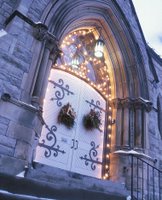 The wreath is found in homes year round; however, during the holidays, they become more prominent. Decorative wreaths find their way onto front doors, and advent wreaths become the centerpiece on many tables around the world. The wreath dates back to the ancient Persian Empire. They were originally called “diadems” and were used to crown the victors of the Olympic Games. The diadems were initially made from laurel leaves, but once the Olympics began to move to different towns, they would be made from the branches of local trees. These crowns were then hung on walls in remembrance of their victory won.
The origin of the Advent wreath dates back to the pre-Christian Germanic people who would gather evergreen branches and light fires during the cold winters of Eastern Europe as a symbol of their hope for the coming spring. Christians maintained this tradition, and by the 16th century, both Catholics and Protestants alike, used this custom to celebrate their true Hope in Christ Jesus—the eternal Light.
This ringed symbol reminds us of another emblem of hope. However, this one wasn’t given after the victory; it was worn during the battle. It wasn’t meant for glory, but for shame. It wasn’t donned by an Olympic champion, but by a King—the Eternal King—during His darkest hour. It was a symbol of agony, embarrassment, torture, and ridicule.
This holiday season, as you scamper from mall to mall and visit home after home, notice the wreaths hanging on the doors. Acknowledge their beauty. Remember the victory and hope this decoration originally symbolizes. And be empowered by the victory and the hope we have today given to us by our King. Not a king to be mocked, but a King to be worshipped and loved.
 The wreath is found in homes year round; however, during the holidays, they become more prominent. Decorative wreaths find their way onto front doors, and advent wreaths become the centerpiece on many tables around the world. The wreath dates back to the ancient Persian Empire. They were originally called “diadems” and were used to crown the victors of the Olympic Games. The diadems were initially made from laurel leaves, but once the Olympics began to move to different towns, they would be made from the branches of local trees. These crowns were then hung on walls in remembrance of their victory won.
The origin of the Advent wreath dates back to the pre-Christian Germanic people who would gather evergreen branches and light fires during the cold winters of Eastern Europe as a symbol of their hope for the coming spring. Christians maintained this tradition, and by the 16th century, both Catholics and Protestants alike, used this custom to celebrate their true Hope in Christ Jesus—the eternal Light.
This ringed symbol reminds us of another emblem of hope. However, this one wasn’t given after the victory; it was worn during the battle. It wasn’t meant for glory, but for shame. It wasn’t donned by an Olympic champion, but by a King—the Eternal King—during His darkest hour. It was a symbol of agony, embarrassment, torture, and ridicule.
They stripped him and put a scarlet robe on him, and then twisted together a crown of thorns and set it on his head. They put a staff in his right hand and knelt in front of him and mocked him. “Hail, king of the Jews!” Matthew 27:28-29 NIVWhile they mocked Him, He persisted. While Satan delighted in his potential conquest over “the Christ,” Jesus endured. While He was being crowned as a powerless king, Jesus showed them exactly what a King should do. A king rules. A king triumphs. But most importantly, a king protects his kingdom. This King did just that. He knew the only way to win was if He fought the battle. Satan handed Him death, and the Creator of the universe, created life once again—eternal Life.
This holiday season, as you scamper from mall to mall and visit home after home, notice the wreaths hanging on the doors. Acknowledge their beauty. Remember the victory and hope this decoration originally symbolizes. And be empowered by the victory and the hope we have today given to us by our King. Not a king to be mocked, but a King to be worshipped and loved.
Friday, September 23, 2005
Purpose
 Well, it has been awhile since my last post (sorry, to all my dedicated fans out there. :) ). I guess you could say I haven’t been that inspired lately. However, today is different.
Today is the birthday of a dear friend of mine who lives in Colorado (Happy Birthday, Ethan!!) In keeping with the age of text messages, g-mail, and e-vites, I decided to him an e-card. As I was eagerly looking through the vast array of e-cards, I stumbled upon one that, from the picture, looked as if it would be perfect for Ethan. When I previewed my selection, I found it to be more fitting than I had originally hoped.
Purpose to seek HimThis e-card proved to serve in me as a reminder. A reminder of who I am, what I am, and whose I am. Who am I? I’m Adam Haynes. Husband of Danielle. Son of James & Kaye. Brother of Amanda. I am me. No one else is me. I am the only me there has ever been or ever will be (hey...no comments out there). Whose am I? I am my Creator’s. My life is His who created it. I am my Savior’s. My life is His who saved it. What am I? Fallen. Fallen from the place God intended me to be. Created by God in perfection. Born by man in sin. Fallen.
He will be your reward
Purpose to know Him
He will reveal Himself to you
Purpose to follow Him
He will lead the way
Purpose to enjoy Him
He will be your closest friend
Purpose to praise Him
He will be your song
Purpose to trust Him
He will be your provider
On your birthday, may your heart rejoice in all He has done for you.
The Lord will fulfill His purpose for me… Psalm 138:8
God designed our hearts, our minds, our emotions, our thoughts, everything that we are to be aligned with His. And yet, in our pride and arrogance—in our sin, we destroyed the divine order of our very being. We as citizens of the human race can no longer naturally seek Him, enjoy Him, or trust Him. Instead, our inner most desires yield selfishness, contempt, anxiety, deception, doubt, etc.
BUT…
Then came grace. Through God’s grace and the death and resurrection of Jesus Christ, our souls have been restored. We can begin anew. Our hearts can again sing praises to Him. Our lives can again be a sweet aroma to Him. We have been lifted from the fallen state in which we’d wallowed, and in His strength, we have been raised into a relationship that is right.
It’s not easy though—as the old adage says, “Old habits die hard.” We must now work for that relationship that was intended to come so easily. We must be diligent in seeking God. We must be attentive to hear from God. We must purpose to follow Him.
purposeMerriam Webster used the verb "aim" to define purpose. On the flip side, sin is defined as “missing the mark.” We must set our hearts to know Him. We must aim—purpose—to enjoy Him. And in this, God will fulfill His purpose for us.
Function: transitive verb
Inflected Form(s): pur•posed; pur•pos•ing
: to propose as an aim to oneself
Now back to my birthday wishes. For those of you that may not know Ethan Moore, he is one of the truest people I know. And by that I mean, he knows who he is and whose he is. He seeks the Lord genuinely and, in that, finds his purpose. Ethan has purposed in his heart to know God. And faithfully, God has revealed Himself to him and is working through Ethan and his ministry. Happy birthday, brother!
Friday, September 02, 2005
A Week of Confusion
Well, almost a week has passed since the devastating tragedy of Hurricane Katrina. Unless you have been keeping residence in your own personal cave, you have witnessed the shocking videos and images of the destruction that has, and is still taking place. “How did this happen?” and “Could it have been prevented?” have all run through our minds as of late.
 I must admit, this catastrophe has been somewhat of a paradox for me. Every night as I get a glimpse of the ruin that used to be New Orleans, I am overcome with grief and sorrow for the faces that embrace my television—the one being relocated from one shelter to the next, the one laying on the side of the road beside their departed spouse, the face of an 8 year old child clinging to her mother’s side scared and bewildered with no comprehension of how severe the situation actually is. My heart breaks.
However, I, too, sit in bewilderment. Here is an entire city that has grown and has been developed, not only around water, but actually on the soggy marshes of the bayou, located on the Gulf of Mexico—a gulf known for attracting tropical storms and nurturing them to hurricane status. With their location, coupled with their “lack” of elevation, were the people prepared for what might happen? Or was their mentality much like ours in everyday life, “It won’t happen to us. Those things only happen to other people.”
I can’t help but think, “You had to have known this could happen. At any given moment, your house and all your belongings, could be sitting under 10 feet of water.” It’s only logical. When you hear about the “bowl effect” of New Orleans, you realize it is an obvious threat to the way of life of those who live there.
My wife and I used to live in the high Rocky Mountains of Colorado. We have seen a multitude of homes built literally feet away from the edges of cliffs which, in an instant, could crumble into nothing. Kentucky, Tennessee, and Arkansas possess the New Madrid Fault which could shift and destroy thousands of homes. California has the San Andreas Fault. Texas, Nebraska, Kansas and Oklahoma have “Tornado Alley.” Washington even sits on active Mt. St. Helens. All who live in areas such as these, have to understand, accept, and especially prepare for what could and probably will happen eventually. Don’t they?
And so I sit, mourning the loss that has overtaken us—the loss of spirit, belongings, and life; and yet I am so appreciative for what I have been blessed with. Then there are the muddled up emotions of confusions of how this could have happened and how it caught them so off guard. I sit in awe.
Times like these truly bring out the truths of God’s Word. Isaiah 40:8 “The grass withers and the flowers fall, but the word of our God stands forever.” No matter what we may “have,” it is only ours for a moment. The only thing God blesses us with that is eternal is the word of God—which is life in His Son, Jesus Christ.
To all those who have been affected by Hurricane Katrina, you are in our prayers.
Subscribe to:
Posts (Atom)